
Text Input
Text Inputs allow users to enter words, numbers, or characters without styling.
Anatomy

- Label: Title of the Text Input.
- Input Container: Rectangular container that houses the placeholder and input text.
- Placeholder/Input Text: Placeholder text is optional and shows an example of how to format the text for what the input is used for.
Usage Guidance
- Text Inputs can only support words, numbers or characters.
- Standard and Wide Text Inputs does not support images or any text styling.
- To ensure we don’t overwhelm users, there shouldn’t be more than two Wide Text Inputs on a page.
- For all Text Inputs on Web, a user clicking into an input or label that is not disabled will trigger the text cursor to appear, allowing users the ability to type. As the user types in the Text Input, the placeholder text is replaced with the user’s input.
When to Use
- Text Input is typically a form element used to collect user data that includes words, numbers or characters.
When to Use Something Else
- If styling is needed, such as for configuring email messages, you can use a Rich Text Editor instead.
- Use a Text Area when you need to let users enter an amount of text that’s longer than a single line.
- Consider using a Select, Radio or Checkboxes if there are predetermined data that a user should not input themselves.
Examples
Basic Example
Text Input should be used in tandem with Form Field to meet accessibility standards.
Disabled
Set the disabled prop of the Text Input to prevent users from interacting with it.
Placeholder
Set the placeholder prop of the Text Input to display a sample of its expected format or value
before a value has been provided.
Ref Forwarding
Text Input supports ref forwarding. It will forward
ref to its underlying <input type="text"> element.
Grow
Set the grow prop of the wrapping Form Field to true to configure the Text Input to expand to
the width of its container.
The grow prop may also be applied directly to the Text Input if Form Field is not being used.
Label Position
Set the labelPosition prop of the wrapping Form Field to designate the position of the label
relative to the Text Input. labelPosition accepts the following values:
FormField.LabelPosition.Top(Default)FormField.LabelPosition.Left
Required
Set the required prop of the wrapping Form Field to true to indicate that the field is required.
Labels for required fields are suffixed by a red asterisk.
Icons
InputGroup is available to add icons to the TextInput. Internally, a container div element is
used with relative position styling on the div and absolute position styling on the start and end
icons. InputGroup.InnerStart and InputGroup.InnerEnd are used to position elements at the start
and end of the input. "start" and "end" are used instead of "left" and "right" to match
CSS Logical Properties
and will be semantically correct in left-to-right and right-to-left languages.
InputGroup.InnerStart and InputGroup.InnerEnd subcomponents can handle any child elements, but
are built for icons. The default width is 40px, which is perfect for icons. If you need to use
something else, be sure to set the width property of InputGroup.InnerStart or
InputGroup.InnerEnd to match the intended width of the element.
Error States
Set the error prop of the wrapping Form Field to FormField.ErrorType.Alert or
FormField.ErrorType.Error to set the Text Input to the Alert or Error state, respectively. You
will also need to set the hintId and hintText props on the Form Field to meet accessibility
standards.
The error prop may be applied directly to the Text Input with a value of
TextInput.ErrorType.Alert or TextInput.ErrorType.Error if Form Field is not being used.
Alert
Alert: Please enter a valid email.
Error
Error: Please enter a valid email.
Component API
TextInput
Props
Props extend from input. Changing the as prop will change the element interface.
| Name | Type | Description | Default |
|---|---|---|---|
error | | The type of error associated with the TextInput (if applicable). | |
width | number | string | The width of the TextInput. | |
theme | | ||
grow | boolean | True if the component should grow to its container's width. False otherwise. | |
children | React.ReactNode | ||
as | React.ElementType | Optional override of the default element used by the component. Any valid tag or Component. If you provided a Component, this component should forward the ref using Note: Not all elements make sense and some elements may cause accessibility issues. Change this value with care. | input |
ref | React.Ref<R = input> | Optional ref. If the component represents an element, this ref will be a reference to the real DOM element of the component. If |
TextInput.ErrorType
Basic type information:
ErrorTypeInputGroup
An InputGroup is a container around a with optional inner start and end
elements. The inner start and end elements are usually icons or icon buttons visually represented
inside the input. The InputGroup will add padding to the input so the icons/buttons display
correctly. This component uses React.Children.map and React.cloneElement from the
React.Children API. This means all children must be
InputGroup.* components. Any other direct children will cause issues. You can add different
elements/components inside the and
subcomponents.
<InputGroup><InputGroup.InnerStart as={SystemIcon} pointerEvents="none" icon={searchIcon} /><InputGroup.Input /><InputGroup.InnerEnd><TertiaryButton tabIndex={-1} icon={xIcon} size="small" /></InputGroup.InnerEnd></InputGroup>
Layout Component
InputGroup supports all props from thelayout component.
Props
Props extend from div. Changing the as prop will change the element interface.
Props extend from . If a model is passed, props from InputGroupModelConfig are ignored.
| Name | Type | Description | Default |
|---|---|---|---|
children | ReactNode | ||
as | React.ElementType | Optional override of the default element used by the component. Any valid tag or Component. If you provided a Component, this component should forward the ref using Note: Not all elements make sense and some elements may cause accessibility issues. Change this value with care. | div |
ref | React.Ref<R = div> | Optional ref. If the component represents an element, this ref will be a reference to the real DOM element of the component. If | |
model | | Optional model to pass to the component. This will override the default model created for the component. This can be useful if you want to access to the state and events of the model, or if you have nested components of the same type and you need to override the model provided by React Context. | |
elemPropsHook | ( | Optional hook that receives the model and all props to be applied to the element. If you use this, it is your responsibility to return props, merging as appropriate. For example, returning an empty object will disable all elemProps hooks associated with this component. This allows finer control over a component without creating a new one. |
InputGroup.InnerStart
A component to show inside and at the start of the input. The input's padding will be
adjusted to not overlap with this element. Use width (number of pixels only) to adjust the
width offset. The width defaults to 40px which is the correct width for icons or icon
buttons.
Layout Component
InputGroup.InnerStart supports all props from thelayout component.
Props
Props extend from div. Changing the as prop will change the element interface.
| Name | Type | Description | Default |
|---|---|---|---|
children | ReactNode | ||
as | React.ElementType | Optional override of the default element used by the component. Any valid tag or Component. If you provided a Component, this component should forward the ref using Note: Not all elements make sense and some elements may cause accessibility issues. Change this value with care. | div |
ref | React.Ref<R = div> | Optional ref. If the component represents an element, this ref will be a reference to the real DOM element of the component. If | |
model | | Optional model to pass to the component. This will override the default model created for the component. This can be useful if you want to access to the state and events of the model, or if you have nested components of the same type and you need to override the model provided by React Context. | |
elemPropsHook | ( | Optional hook that receives the model and all props to be applied to the element. If you use this, it is your responsibility to return props, merging as appropriate. For example, returning an empty object will disable all elemProps hooks associated with this component. This allows finer control over a component without creating a new one. |
InputGroup.Input
The input to render. By default, this is a . Use the as prop to change the
component to be rendered.
Layout Component
InputGroup.Input supports all props from thelayout component.
Props
Props extend from . Changing the as prop will change the element interface.
| Name | Type | Description | Default |
|---|---|---|---|
children | ReactNode | ||
as | React.ElementType | Optional override of the default element used by the component. Any valid tag or Component. If you provided a Component, this component should forward the ref using Note: Not all elements make sense and some elements may cause accessibility issues. Change this value with care. | |
ref | React.Ref<R = > | Optional ref. If the component represents an element, this ref will be a reference to the real DOM element of the component. If | |
model | | Optional model to pass to the component. This will override the default model created for the component. This can be useful if you want to access to the state and events of the model, or if you have nested components of the same type and you need to override the model provided by React Context. | |
elemPropsHook | ( | Optional hook that receives the model and all props to be applied to the element. If you use this, it is your responsibility to return props, merging as appropriate. For example, returning an empty object will disable all elemProps hooks associated with this component. This allows finer control over a component without creating a new one. |
InputGroup.InnerEnd
A component to show inside and at the end of the input. The input's padding will be adjusted
to not overlap with this element. Use width (number of pixels only) to adjust the width
offset. The width defaults to 40px which is the correct width for icons or icon buttons
within the input.
Layout Component
InputGroup.InnerEnd supports all props from thelayout component.
Props
Props extend from div. Changing the as prop will change the element interface.
| Name | Type | Description | Default |
|---|---|---|---|
children | ReactNode | ||
as | React.ElementType | Optional override of the default element used by the component. Any valid tag or Component. If you provided a Component, this component should forward the ref using Note: Not all elements make sense and some elements may cause accessibility issues. Change this value with care. | div |
ref | React.Ref<R = div> | Optional ref. If the component represents an element, this ref will be a reference to the real DOM element of the component. If | |
model | | Optional model to pass to the component. This will override the default model created for the component. This can be useful if you want to access to the state and events of the model, or if you have nested components of the same type and you need to override the model provided by React Context. | |
elemPropsHook | ( | Optional hook that receives the model and all props to be applied to the element. If you use this, it is your responsibility to return props, merging as appropriate. For example, returning an empty object will disable all elemProps hooks associated with this component. This allows finer control over a component without creating a new one. |
InputGroup.ClearButton
A component that can be added to an input group that will clear the input. It will only render when the input has a value and will fade when a value is entered.
Layout Component
InputGroup.ClearButton supports all props from thelayout component.
Props
Props extend from . Changing the as prop will change the element interface.
| Name | Type | Description | Default |
|---|---|---|---|
variant | 'inverse' | undefined | The variant of the TertiaryButton. | |
size | | There are four button sizes: | |
iconPosition | | Button icon positions can either be | |
icon | | The icon of the TertiaryButton. | |
shouldMirrorIcon | boolean | If set to | |
allCaps | boolean | If set to | |
children | ReactNode | ||
isThemeable | boolean | If set to | |
theme | | ||
fill | | The fill color of the SystemIcon. This overrides | |
color | | The color of the SystemIcon. This defines | |
styles | | ||
shouldMirror | boolean | If set to | false |
background | | The background color of the SystemIcon. | |
accent | | The accent color of the SystemIcon. This overrides | |
accentHover | | The accent color of the SystemIcon on hover. This overrides | |
backgroundHover | | The background color of the SystemIcon on hover. | |
colorHover | | The hover color of the SystemIcon. This defines | |
fillHover | | The fill color of the SystemIcon on hover. This overrides | |
colors | | Override default colors of a button. The default will depend on the button type | |
fillIcon | boolean | Whether the icon should received filled (colored background layer) or regular styles.
Corresponds to | |
grow | boolean | True if the component should grow to its container's width. False otherwise. | |
as | React.ElementType | Optional override of the default element used by the component. Any valid tag or Component. If you provided a Component, this component should forward the ref using Note: Not all elements make sense and some elements may cause accessibility issues. Change this value with care. | |
ref | React.Ref<R = > | Optional ref. If the component represents an element, this ref will be a reference to the real DOM element of the component. If | |
model | | Optional model to pass to the component. This will override the default model created for the component. This can be useful if you want to access to the state and events of the model, or if you have nested components of the same type and you need to override the model provided by React Context. | |
elemPropsHook | ( | Optional hook that receives the model and all props to be applied to the element. If you use this, it is your responsibility to return props, merging as appropriate. For example, returning an empty object will disable all elemProps hooks associated with this component. This allows finer control over a component without creating a new one. |
useClearButton
(
model: ,
elemProps: {},
ref: React.Ref
) => {
role: 'presentation';
tabIndex: unknown {
"kind": "unknown",
"value": "unknown",
"text": "SyntheticNode - PrefixUnaryExpression"
};
icon: ;
size: 'small';
transition: 'opacity 300ms ease';
onMouseDown: (event: ) => void;
onClick: () => void;
style: {
opacity: 0 | 1;
pointerEvents: 'auto' | 'none';
};
}Model
Specifications
| Given | When | Then |
|---|---|---|
| given the 'Basic' story is rendered |
| |
| given the 'Basic' story is rendered |
|
|
| given the 'Basic' story is rendered |
|
|
| given the 'Alert' story is rendered |
| |
| given the 'Alert' story is rendered |
|
|
| given the 'Alert' story is rendered |
|
|
| given the 'Error' story is rendered |
| |
| given the 'Error' story is rendered |
|
|
| given the 'Error' story is rendered |
|
|
| given the 'Disabled' story is rendered |
| |
| given the 'Disabled' story is rendered |
| |
| given the 'Placeholder' story is rendered |
| |
| given the 'Placeholder' story is rendered |
| |
| given the 'Placeholder' story is rendered |
|
Accessibility Guidelines
How Text Inputs Impact the Accessible Experience
Programmatically associating labels and instructions to form inputs is one of the most important foundational practices for building accessible forms.
For Text Input, placeholder values are best used for hints or examples of valid input. Designers should avoid relying on placeholder text for explaining the purpose of the input, as placeholders often don’t provide enough contrast against the text input background. In addition to lower contrast, placeholders disappear once users enter information, impacting users with memory loss, cognitive disabilities, or who are simply distracted.
Keyboard Interaction
Each Text Input must have a focus indicator that is highly visible against the background and against the non-focused state. Refer to Accessible Colors for more information.
Text Input must support the following keyboard interactions:
Tab: focus into and out of each text area
Screen Reader Interaction
Text Input must communicate the following to users:
- This component is a text field
- The accessible name (label) describing the purpose of the field
- Text or placeholder values inside the field
- If applicable, whether the field is required, disabled, or invalid
Design Annotations Needed
- No design annotations needed
Implementation Markup Needed
- Text Input must have an
aria-describedbyattribute referencing the uniqueidvalue of the error text when an inline alert or error is shown. - Text Input must have a
requiredattribute when the field is required for form submission. - [Included in component] A
<label>element must be added with aforattribute referencing the uniqueidvalue of the associated text area. - [Included in component] An
aria-invalid=”true”attribute must be set on the Text Input when the field has an error condition. - [Included in component] A
disabledattribute must be set on the Text Input when the field is disabled.
Content Guidelines
- Labels for Text Inputs are written in title case.
- Refer to the guidelines on Placeholder Text in the Content Style Guide for more tips on how to write placeholder text.
Anatomy
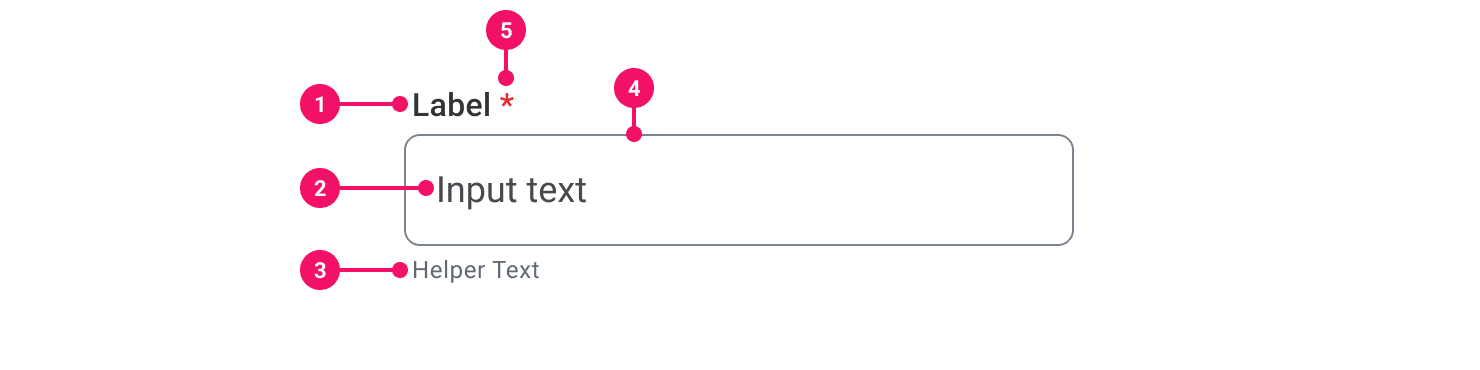
- Label: Text used as a title or brief description of the input.
- Placeholder/Input Text: Placeholder text is optional and shows an example of the intended input.
- Helper Text (Optional): Message to aid in users understanding of acceptable input text.
- Input Container: Rectangular container that houses the placeholder and input text.
- Required Asterisk (Optional): Appears only when the input is required.
Interaction States
Mobile inputs include several interactive states; inactive, active, disabled and pressed states.

Inactive states are the default state if the input is not active, disabled or displaying an alert.

Active states are displayed with a blue border, a cursor, and a keyboard.

Disabled states are grayed out to prevent users from interacting with the input.

While actively pressing on an input, the container fill is displayed in gray to provide feedback to the user of their touch.
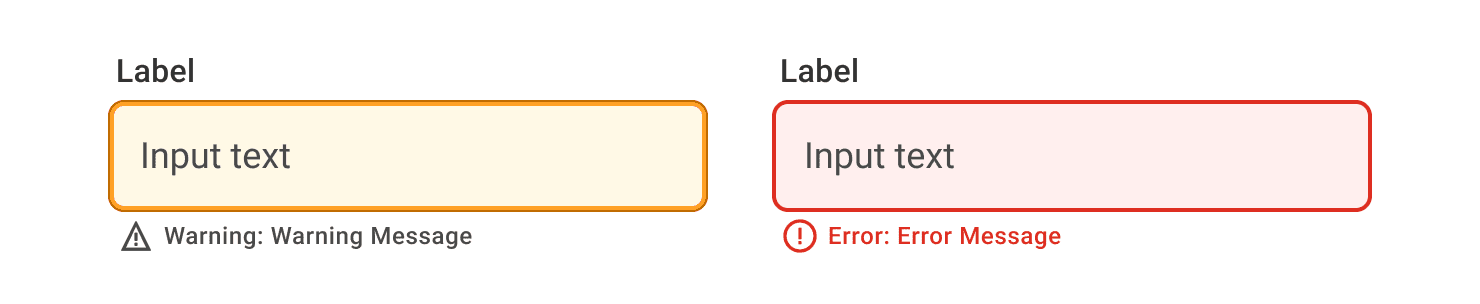
Notification States
Notification states on mobile include an additional visual affordance compared to web notifications. They include an icon and a notification label.
Usage Guidance
When to Use
- A Text Input is used to collect user data that includes words, numbers, or characters.
- Use helper text to instruct the user what the proper input type may be.
- Use placeholder text only to provide examples of proper inputs. Never use placeholder text to help instruct users.
When to Use Something Else
- If the user needs to input a time, use a time picker.
- If the user needs to input a date, use a date picker.
- If input styling is needed, such as for configuring email messages, use a Rich Text Editor.
- Use a Text Area when you need to let users enter an amount of text that’s longer than a single line.
- Consider using a Select, Radio or Checkboxes if there is predetermined data that a user should not input themself.
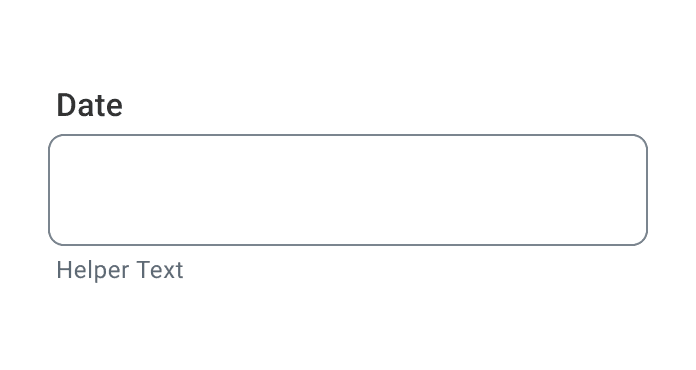
Do
Do use helper text to display important information that aids in the successful completion of an input.
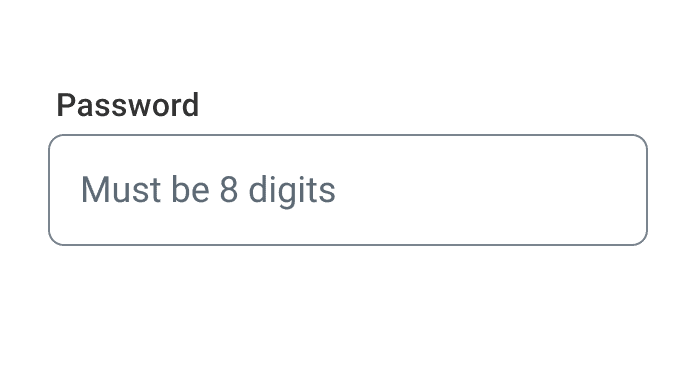
Don't
Don't use instructional text as placeholder text because it will disappear as the user starts typing and will no longer be helpful to the user.
Mobile Guidance
- Mobile text inputs are larger in height to better accommodate finger interaction.
- Mobile text inputs have larger typography for better readability on smaller screens.
Truncation
Labels
Labels should be short and concise. They do not have a limit on how long they may be. Once the label exceeds the length of the container it will wrap to another line.
Helper Text
Helper Text should be short and concise. They do not have a limit on how long they may be. Once helper text exceeds the length of the container it will wrap to another line.
Input Text
When the input text exceeds the length of the container the text becomes truncated at the trailing end of the container while inactive. While actively typing into the input, the text scrolls off the leading edge of the container.
Keyboards
Mobile devices utilize on-screen keyboards. It is often up to the designer to specify keyboard-type in their designs for the intended input. These keyboards vary based on the brand of the device; however, most devices have dedicated keyboards for specific types of inputs such as:
- Alphabetic
- Numeric
- Alphanumeric
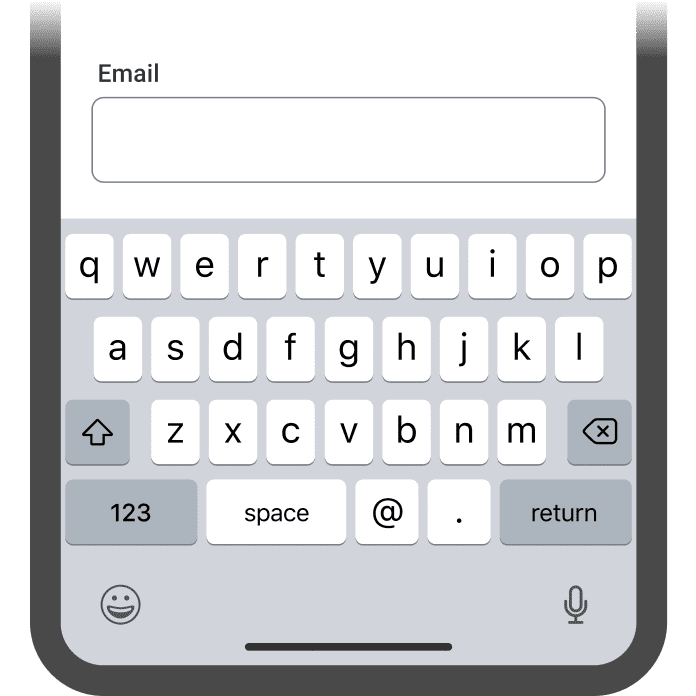
Do
Use the appropriate keyboard based on the intended input.
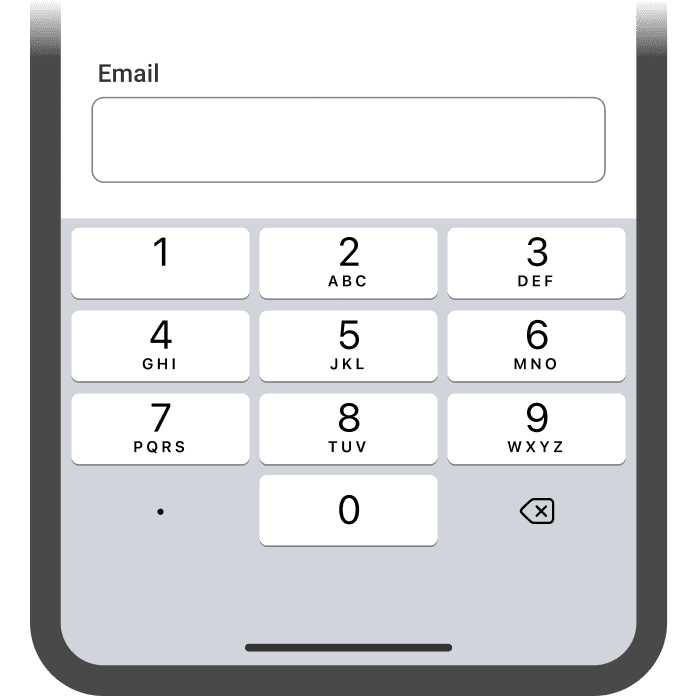
Don't
Don't use the wrong keyboard for an input as this causes more work for the user. This could prevent the user from completing their task.
Screen Size Differences
Typically, inputs on mobile should stretch to the full width of the screen. However, there are some exceptions for providing limited space to set expectations of the input, such as providing a smaller text input box for entering an address ZIP code. For larger mobile devices, inputs should have a maximum width of 600 pts to retain proper readability.
API Documentation
LabelledTextFieldStyle
public struct LabelledTextFieldStyle: TextFieldStyle
WD-standard labelled text field style conforming to Apple's TextFieldStyle protocol.
Methods
init(text:label:accessibilityLabel:textFieldButtonAccessibilityLabel:helperText:context:)
public init(text: Binding<String>,label: String,accessibilityLabel: String,textFieldButtonAccessibilityLabel: String,helperText: String?,context: SemanticContext)
Create an instance of LabelledTextFieldStyle.
Parameters
| Name | Description |
|---|---|
| text | Text binding so the clear button can work, already localized. |
| label | Label to be positioned above field, already localized. |
| accessibilityLabel | Accessibility label of field, already localized. |
| textFieldButtonAccessibilityLabel | Accessibility label of the text field button (re: “x” clear button). |
| helperText | Helper text below field, already localized. |
| context | SemanticContext of the field. |
init(text:label:helperText:context:localizer:)
public init(text: Binding<String>,label: String,helperText: String?,context: SemanticContext,localizer: LocalizationAdapting)
Create an instance of LabelledTextFieldStyle.
Parameters
| Name | Description |
|---|---|
| text | Text binding so the clear button can work, already localized. |
| label | Label to be positioned above field, already localized. |
| helperText | Helper text below field. Helper text will be prefixed with “Error:”/“Warning:” as part of this init. |
| context | SemanticContext of the field. |
| localizer | localizer for the field. |
_body(configuration:)
public func _body(configuration: TextField<Self._Label>) -> some View
Accessibility Guidelines
Refreshed mobile guidelines will be coming soon!
Anatomy
- Label: Text used as a title or brief description of the input.
- Placeholder/Input Text: Placeholder text is optional and shows an example of the intended input.
- Helper Text (Optional): Message to aid in users understanding of acceptable input text.
- Input Container: Rectangular container that houses the placeholder and input text.
- Required Asterisk (Optional): Appears only when the input is required.
Interaction States
Mobile inputs include several interactive states; inactive, active, disabled and pressed states.
Inactive states are the default state if the input is not active, disabled or displaying an alert.
Active states are displayed with a blue border, a cursor, and a keyboard.
Disabled states are grayed out to prevent users from interacting with the input.
While actively pressing on an input, the container fill is displayed in gray to provide feedback to the user of their touch.
Notification States
Notification states on mobile include an additional visual affordance compared to web notifications. They include an icon and a notification label.
Usage Guidance
When to Use
- A Text Input is used to collect user data that includes words, numbers, or characters.
- Use helper text to instruct the user what the proper input type may be.
- Use placeholder text only to provide examples of proper inputs. Never use placeholder text to help instruct users.
When to Use Something Else
- If the user needs to input a time, use a time picker.
- If the user needs to input a date, use a date picker.
- If input styling is needed, such as for configuring email messages, use a Rich Text Editor.
- Use a Text Area when you need to let users enter an amount of text that’s longer than a single line.
- Consider using a Select, Radio or Checkboxes if there is predetermined data that a user should not input themself.
Do
Do use helper text to display important information that aids in the successful completion of an input.
Don't
Don't use instructional text as placeholder text because it will disappear as the user starts typing and will no longer be helpful to the user.
Mobile Guidance
- Mobile text inputs are larger in height to better accommodate finger interaction.
- Mobile text inputs have larger typography for better readability on smaller screens.
Truncation
Labels
Labels should be short and concise. They do not have a limit on how long they may be. Once the label exceeds the length of the container it will wrap to another line.
Helper Text
Helper Text should be short and concise. They do not have a limit on how long they may be. Once helper text exceeds the length of the container it will wrap to another line.
Input Text
When the input text exceeds the length of the container the text becomes truncated at the trailing end of the container while inactive. While actively typing into the input, the text scrolls off the leading edge of the container.
Keyboards
Mobile devices utilize on-screen keyboards. It is often up to the designer to specify keyboard-type in their designs for the intended input. These keyboards vary based on the brand of the device; however, most devices have dedicated keyboards for specific types of inputs such as:
- Alphabetic
- Numeric
- Alphanumeric
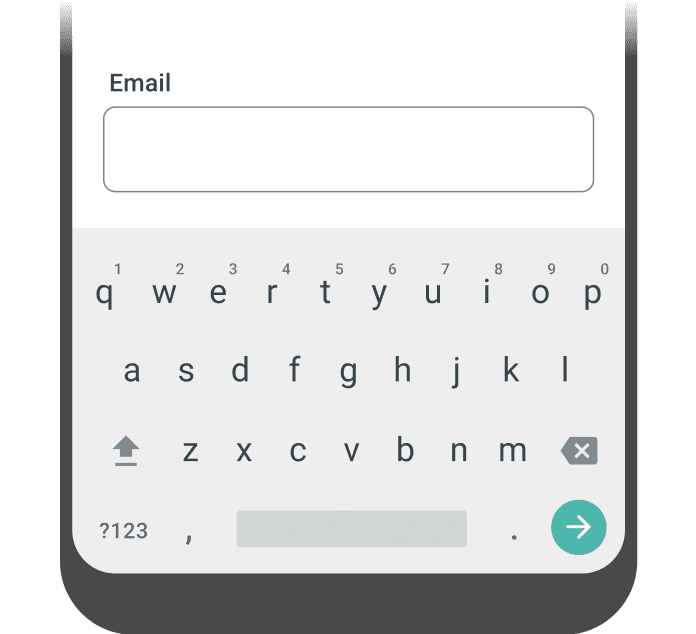
Do
Use the appropriate keyboard based on the intended input.
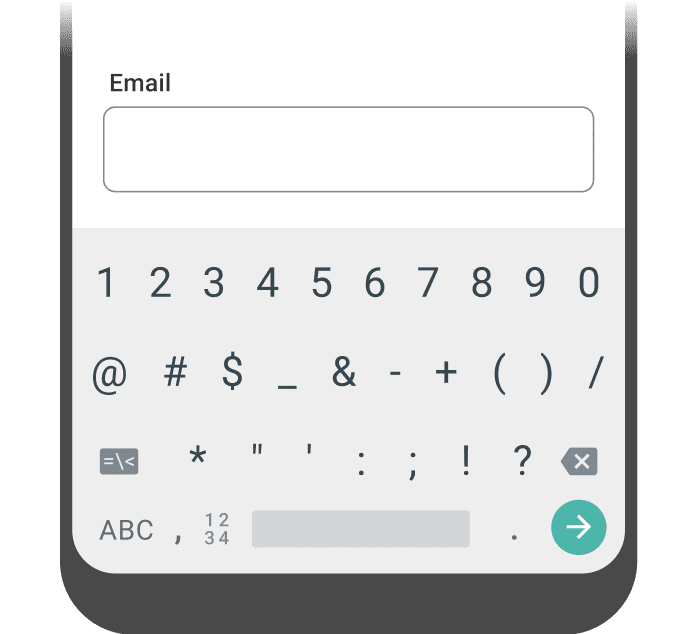
Don't
Don't use the wrong keyboard for an input as this causes more work for the user. This could prevent the user from completing their task.
Screen Size Differences
Typically, inputs on mobile should stretch to the full width of the screen. However, there are some exceptions for providing limited space to set expectations of the input, such as providing a smaller text input box for entering an address ZIP code. For larger mobile devices, inputs should have a maximum width of 600 pts to retain proper readability.
API Documentation
Component Definition
@Composablefun TextInputUiComponent(modifier: Modifier = Modifier,label: String? = null,value: String,onValueChange: (String) -> Unit,readOnly: Boolean = false,placeholder: String? = null,placeholderTextStyle: TextStyle = WorkdayTheme.canvasTypography.bodyMedium,heightConfig: TextInputHeightConfig = singleLineConfig(),interactionSource: MutableInteractionSource = remember { MutableInteractionSource() },leadingIcon: @Composable (() -> Unit)? = null,trailingIcon: @Composable (() -> Unit)? = null,helperText: String? = null,onClickInputText: (() -> Unit) = {},onClickClearTextIcon: (() -> Unit) = {},keyboardOptions: KeyboardOptions = KeyboardOptions.Default,keyboardActions: KeyboardActions = KeyboardActions(),semanticState: SemanticState = SemanticState()) {
Parameters
All undocumented parameters are native Android Compose types that can be found in the developer documentation.
| Name | Type | Default | Description |
|---|---|---|---|
| label | String? | null | The text above the input that typically designates the name of the component |
| value | String | The text to be displayed inside of the text input | |
| onValueChange | (String) -> Unit) | Callback lambda that is executed whenever the text of the input changes. | |
| readOnly | Boolean | false | Removes the ability for user input into the text input. The entire Input surface provides a ripple click animation when readOnly is set to true. |
| placeholder | String? | null | This text is shown inside of the input when the value is empty to provide a hint to the user. |
| placeholderTextStyle | TextStyle | bodySmall | Configures the placeholder typography style. |
| heightConfig | TextInputHeightConfig | singleLineConfig() | Toggles between a TextInput and TextArea UI Component. Provides min height and fixed height configurations for multi-line inputs. |
| leadingIcon | Composable? | null | Icon composable rendered at the start of the input area. |
| trailingIcon | Composable? | null | Icon composable rendered at the end of the input area. |
| helperText | String? | null | Helper text is displayed underneath the input area that to give additional context to the user. Error and Alert helper text prefixes are localized and automatically displayed when the component’s semantic state is changed |
| onClickInputText | (() -> Unit) | {} | Callback lambda that is executed when the user clicks on the Input area. |
| onClickClearTextIcon | (() -> Unit) | {} | Callback lambda that is executed when the user clicks on the “clear text” trailing Icon that is displayed while the component is focused. |
| semanticState | SemanticState | SemanticState() | Adjusts the state of the Component. This allows for enabling, disabling, warning, error, and required states. |
Accessibility Guidelines
Refreshed mobile guidelines will be coming soon!
Can't Find What You Need?
Check out our FAQ section which may help you find the information you're looking for. For further information, contact the #canvas or #canvas-kitchannels on Slack.
FAQ Section